

The MOUSE lab has been doing well in the past eight years: we’ve had a good stream of publications from the investigations we’ve been involved in. Besides publications, we’re also (t)asked to get funding, in particular to bring people to the lab. I’m not the most successful at writing these myself – I excel in other aspects of science – so joining other projects seems to be the more effective approach. If you have a project on topics of reference materials, energy storage materials or composites, and you need a lab for doing highly customizable and automated lab X-ray scattering experiments, here’s our pitch:
Expertise:

With about two decades of expertise in scattering methodology and practical application, we’re ideally suited to bring nanostructural insight via X-ray scattering to your project. Combined with the expertise available at the institute on a very diverse range of topics, this taps into a wealth of information that will leave no stone unturned in the investigation.
In particular, we’re able to provide support on data collection, processing, analysis and interpretation, and are capable of implementing a high degree of lab automation. This lab automation, combined (and integrated) with high throughput X-ray scattering lets us collect vast quantities of data with relative ease, and is ideal for gaining a comprehensive insight into your processes.
The lab’s mission is to strive for correctness over speed, we take care of our reputation and the value of our data. We guarantee that the data is as good as we can make it at that point in time, without bullshit, and constantly work on improving our methods. Our extensive teaching and outreach experience also helps to make complex scattering concepts accessible to a broad audience.

Labs, well-funded equipment and software:
We are working in a well-funded German institute. Practically this means that, despite the general lack of people that almost every institute seems to suffer from, we’re definitely not lacking in equipment. with the well-maintained MOUSE instrument, we have a very capable and adaptable X-ray scattering instrument. It is supplemented by a wide range of equipment. This includes, amongst others:
- extra motor controllers and stages for GI and USAXS
- chillers and other temperature control equipment
- a robot arm (mecademic meca500),
- liquid handling equipment such as excellent syringe and peristaltic pumps, valves, hotplates and other bits and bobs
- low- and high-vacuum equipment
- electronic and measurement equipment such as cameras, high-power DC power supplies, lock-in amplifiers and (as of last week) a Keithley 2460 sourcemeter for electrochemical experiments.
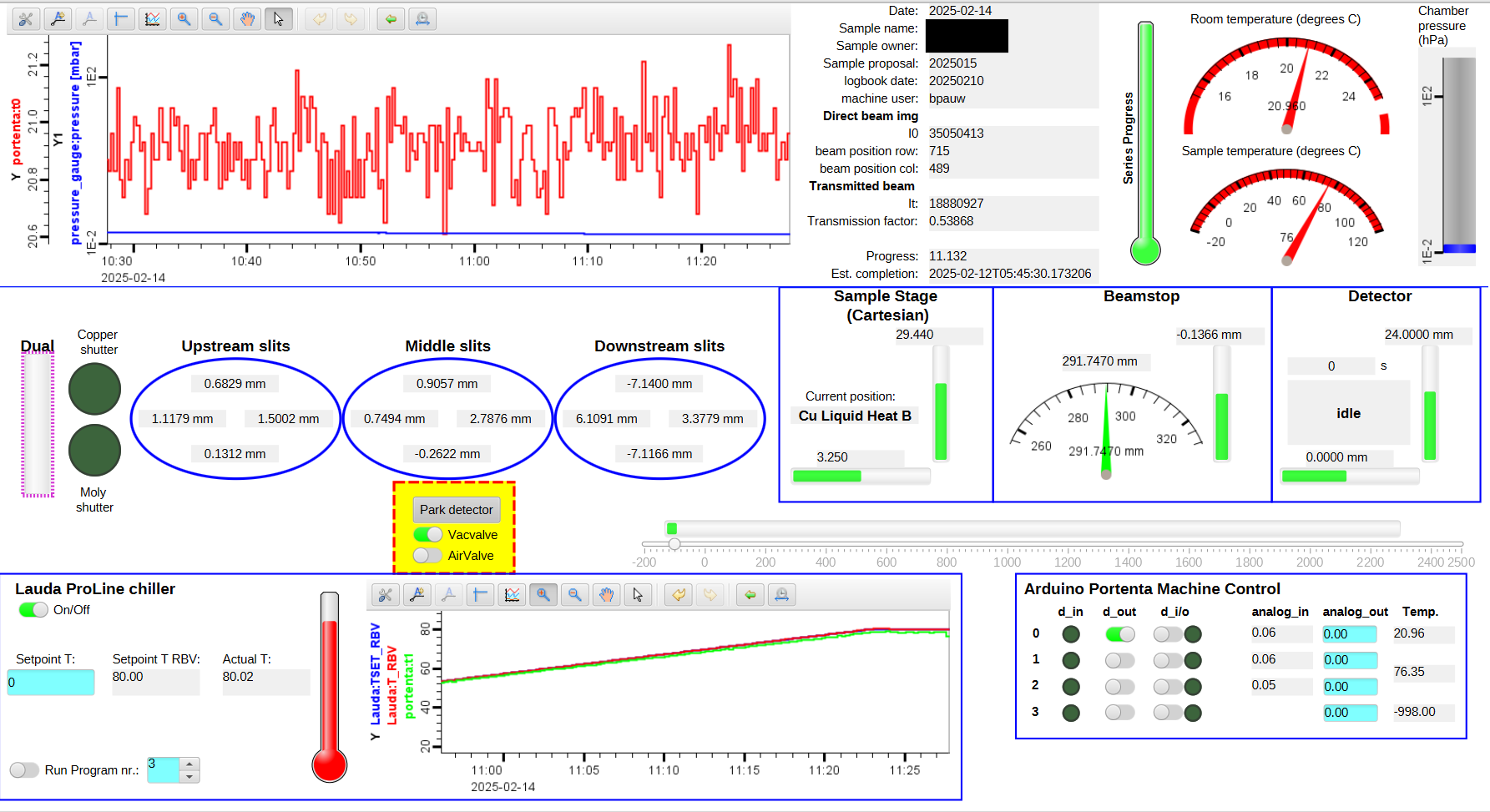
All this equipment is integrated in our EPICS control system, and can be orchestrated using Python (via Bluesky). We’re constantly improving the equipment and integration, to make the system more robust and flexible.
Besides maintaining the hardware, we also maintain a suite of software, including software for processing, analysis and simulation of scattering data, besides some educational software for teaching purposes.

Around BAM, both in our group as well as in other groups there’s additional equipment that is accessible, including
- dynamic and static light scattering
- many well-equipped synthesis labs
- IR, UV-Vis, DSC, TGA, isothermal calorimetry, dynamic-mechanical analysis
- Two SAXSess instruments with Mythen detectors on modern X-ray generators.
- Electron microscopes of all flavours.
- a range of scanning probe microscopes, including an IR-AFM
- two-photon polymerisation, now specialising in microprinting of ceramic composites
- NMR, X-ray tomography, XRD, and even a materials science beamline
A highly adaptable and flexible environment:

Our lab encourages modification of the lab equipment, no idea is too wild. What we need, we may be able to buy or (preferably) build. We have well-equipped mechanical workshops on campus able to turn ideas into reality rapidly. Furthermore, our institute strongly supports open source and open access and encourages its use.
We also have an eScience department taking care of the more demanding computational and ML-related challenges. Here a full team is developing modern technologies to help speed science along, and is ready to contribute to exciting data-driven investigations.
Lastly, Berlin is – in the spring, summer, and autumn at least – a highly desirable place to be with something for everyone. This can range from good food, to excellent sports facilities, to a smattering of music and event venues. Ideal for hosting a project workshop or conference.

What we’re asking for:
What we would be asking for (depending on degree of involvement) is capacity: we need people to realise the potential of the laboratory. If there is space in your funding budget for a post-doc or Ph.D. student, they will be able to carry out the project work under our joint supervision.
As mentioned before, we’re focusing at the moment on projects revolving around reference materials and -methods, energy storage (e.g. battery materials) and composites, and we’re looking to join projects that focus on these. We encourage you to contact us so we can discuss possibilities and align expectations. Drop me a line at Brian [dot] pauw [at] bam [dot] de to get the ball rolling!
